

I remember the exact moment I realized my office chair was the enemy. I was 27, working from home, and my lower back felt like someone had replaced my spine with a rusty spring. I blamed my mattress, my posture, even my genes. Then I sat on the floor one day to stretch and noticed something: my back didn’t hurt when I wasn’t in my chair.
That’s when it hit me. My chair—a perfectly respectable, mid-range ergonomic model—had lost its lumbar support years ago. I just didn’t notice because it happened slowly, like a frog in boiling water.
The solution wasn’t a $1,000 new chair. It was a $40 cushion that filled the gap my chair had left behind.
Why Your Back Hurts After Sitting
Here’s what’s happening inside your spine: your lower back has a natural inward curve called lordosis. When you sit without proper support, that curve flattens out. Your spinal discs get compressed unevenly, your deep postural muscles (the multifidus and erector spinae) work overtime to keep you upright, and eventually, they give up.
The result? That dull ache at the end of the day, the stiffness when you stand up, the nagging feeling that your back is slowly betraying you.
A good lumbar support cushion fixes this by filling the gap between your chair and your spine’s natural curve. It restores that S-shape, redistributes pressure evenly, and lets your muscles finally relax.
But not all cushions are created equal. I’ve tested over a dozen, and here’s what I learned.
How Lumbar Support Actually Works
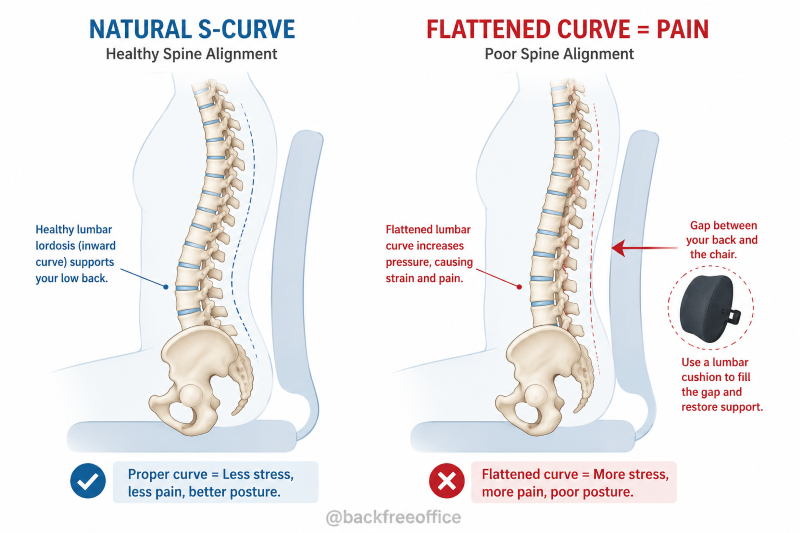
Think of your spine like a suspension bridge. The natural curve of your lower back distributes weight evenly across the structure. When you flatten that curve—by slouching or sitting in a chair with no lumbar support—all that weight shifts to a single point.
A lumbar cushion acts like a brace, restoring the bridge’s natural arch. The key is where it hits your back. The cushion needs to sit at your belt line, not between your shoulder blades. That’s where the curve is.
The best cushions use high-density memory foam that conforms to your unique shape without going flat. They don’t push you forward aggressively—they just fill the space that’s been empty.
What to Look for in a Lumbar Cushion
Shape and Design
The most effective cushions are wider at the bottom and curve inward at the waist to match your spine’s natural shape. Flat rectangles provide generic support at best. Contoured designs, like the AUVON’s patented bulge, offer targeted support exactly where your back needs it.
Material: Memory Foam
Memory foam is the gold standard for a reason. It conforms to your body, provides consistent support without flattening, and bounces back when you stand up. Heat-responsive memory foam is even better—it softens slightly with body heat for a custom fit.
What to avoid: Cheap foam that flattens after a few weeks. You’ll know it when you see it—press your thumb into the center. If it stays compressed, skip it.
Straps and Fit
Dual adjustable straps are a non-negotiable. Single straps slip or don’t reach around wider chairs. Look for cushions with extension pieces that fit chairs up to 32 inches wide.
Quick-release buckles are a bonus—they make it easy to remove the cover for washing.
Breathability and Cover Quality
Nothing ruins a good cushion like a sweaty back. Look for breathable mesh covers, honeycomb fabric, or 3D mesh designs that allow airflow.
A removable, machine-washable cover extends the life of your cushion and keeps it hygienic. It’s not a luxury—it’s a necessity.
Firmness
The cushion should be firm enough to support your spine but comfortable enough for all-day use. You want support, not a brick. Most high-density memory foam cushions hit this sweet spot.
My Top Picks for 2026
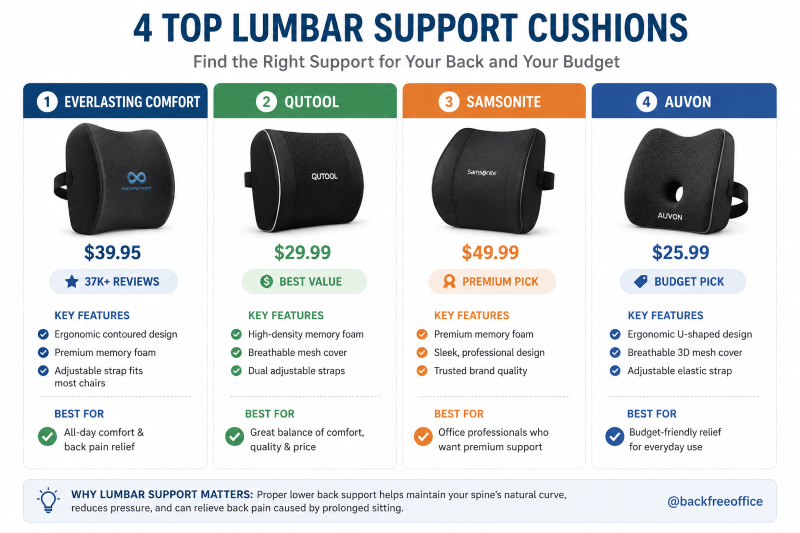
Everlasting Comfort Lumbar Support Pillow – Most Popular Choice
This is the cushion that I purchased and the results were quite surprising. With a consistent 4.4-star rating, it’s the most trusted option on the market.
Key Features:
- High-density memory foam maintains its shape
- Dual adjustable straps with extension pieces fit chairs up to 32 inches
- Breathable mesh cover, machine washable
- 1.5 pounds, lightweight but supportive
Pros:
- Reliable support proven by thousands of users
- Fits most standard office chairs securely
- Cover comes off easily for washing
Cons:
- Takes up 2-3 inches of seat depth—shorter users may feel pushed forward
- May feel too firm initially; give it a week to break in
- Straps can lose tension over time with heavy use
Best for: Office workers spending 6+ hours a day at a desk who want proven, reliable support.
Who should skip: If you have a gaming chair with prominent side bolsters, this may not fit between the wings. Also consider alternatives if you prefer a softer feel.
QUTOOL Lumbar Support Pillow – Best Value
The #1 Best Seller in its category with thousands of reviews, the QUTOOL delivers premium quality at a budget-friendly price .
Key Features:
- High-density foam that genuinely doesn’t flatten
- Upgraded longer straps (improved after customer feedback)
- 3D mesh cover keeps your back cool
- 16.9″ x 15.5″ size fits most users well
Pros:
- Affordable price point (~$32 at the time of writing this article)
- Strong durability—holds shape after months of use
- Breathable design reduces sweating
Cons:
- May feel too firm initially; needs a break-in period
- Best for users under 200 lbs—larger users may find it too narrow
- Not ideal for soft couches or recliners
Best for: Budget-conscious buyers who want proven quality. Great for office workers, drivers, and gamers who need all-day support.
Who should skip: If you weigh over 200 lbs or have a broader back, the width may feel too narrow.
Samsonite Memory Foam Lumbar Support – Best Budget
At about $25, this is the cheapest option I’d actually recommend. Samsonite brings its luggage expertise to back support—and it shows.
Key Features:
- Medium-firm memory foam in a compact profile
- Ventilated mesh cover keeps you cool
- Lightweight design travels easily between chair and car
Pros:
- Affordable and breathable
- Trusted brand with more than 10k reviews
- Works well for laptop users and those in temporary setups
Cons:
- Hollow center may not suit all lower back conditions
- Strap can be loose on some chairs—check compatibility
- Shape tends to soften over time with extended use
Best for: Occasional users, commuters, and anyone on a tight budget.
Who should skip: If you have severe lower back pain or need deep, targeted support, this may not provide enough.
AUVON Lumbar Support Pillow – Best Ergonomic Design
This is the cushion I recommend to anyone with chronic lower back pain. Developed with physical therapists, the patented bulge design targets your lumbar curve with scientific precision.
Key Features:
- Patented bulge design for precision-targeted support
- 4-zone ergonomic structure (upper curve, side wraps, pelvic support, lumbar cushioning)
- Honeycomb breathable fabric for airflow
- 4.5″ thick at the peak
Pros:
- Therapist-informed design provides clinical-grade support
- Excellent airflow keeps you cool
- Anti-slip backing with dual straps stays in place
Cons:
- Thicker design fits fewer chairs—check compatibility
- Straps could be longer for very wide chairs
- May not suit users over 6 feet tall—the fixed bulge targets average torso lengths
Best for: People who want professionally-designed support and don’t mind paying a bit more for it. Also great if you appreciate products developed with medical input.
Who should skip: If you have a chair with limited seat depth or a very wide back, the thickness may cause issues.
How to Position Your Lumbar Cushion Correctly
This is the part most people get wrong. I’ve seen people use lumbar cushions as neck pillows, mid-back supports, and even footrests. Here’s how to do it right:
Step 1: Find Your Belt Line
Sit normally in your chair. Place the cushion at the curve of your lower back—roughly at belt level. Not between your shoulder blades, not on your tailbone. Your belt line.
Step 2: Check the Depth
The cushion should fill the gap between your lower back and the chair without pushing you forward. If you feel like you’re perching on the edge of the chair, the cushion is too thick or positioned too low.
Step 3: Adjust the Straps
Secure the cushion with the dual straps. It should sit snug but not tight—you want gentle, consistent pressure, not discomfort.
Step 4: Test the Position
Lean back. You should feel support exactly where your lower back curves inward, but you shouldn’t feel like you’re being poked. If it’s uncomfortable, adjust the height up or down by an inch.
Step 5: Re-adjust Throughout the Day
Your body shifts. Your chair shifts. The cushion shifts. Check it every couple of hours and reposition as needed.
Common Mistakes to Avoid
Placing the Cushion Too High
The most common mistake. Lumbar support goes at your lower back, not your mid-back or shoulders. If it’s hitting your shoulder blades, it’s too high.
Buying a Flat Cushion Instead of a Contoured One
Flat rectangles provide generic support at best. You need a cushion that actually matches your spine’s curve. This is why contoured designs like the AUVON or Everlasting Comfort outperform cheaper alternatives.
Choosing Based on Price Alone
The cheapest option often flattens within weeks. You’re not saving money—you’re buying a backache. Spend the extra $10-15 for high-density memory foam.
Not Checking Chair Compatibility
Some gaming chairs with bucket seats or prominent side bolsters won’t fit standard lumbar cushions. Measure your chair’s backrest width before buying.
Ignoring the Break-In Period
Most memory foam cushions feel too firm at first. Give them about a week to adapt to your body shape. If they still feel uncomfortable after that, consider a softer option.
Is a Lumbar Cushion Worth It?
I’ll be direct on this one: yes. A quality lumbar support cushion is one of the most cost-effective ways to reduce back pain from sitting. Even a $25 cushion can transform a cheap office chair into something genuinely comfortable.
But here’s the catch: a cushion isn’t a magic bullet. No cushion can replace the benefits of regular movement. Stand, stretch, or walk around every 30–60 minutes to reset your posture and improve circulation. The cushion supports your spine; movement protects it.
I’ve used the Everlasting Comfort for over a year now. My lower back pain has dropped from a daily 6 out of 10 to a 2. That’s a $40 investment that improved my workday, my mood, and my sleep.
Your back is worth the investment.
Key Takeaway Box
| Factor | What to Look For | What to Avoid |
| Shape | Contoured, wider at bottom, curves inward at waist | Flat rectangles |
| Material | High-density memory foam, heat-responsive | Cheap foam that flattens |
| Straps | Dual adjustable, extension pieces for wide chairs | Single strap, no extension |
| Cover | Breathable mesh or honeycomb, machine washable | Non-removable, non-breathable |
| Firmness | Supportive but comfortable | Too soft (no support) or too hard (uncomfortable) |
| Position | Belt line, fills gap without pushing forward | Too high, too low, or too thick |
Try one of these cushions for one week. If your back feels better by Friday, you’ve found your solution. If not, return it and try a different style—every back is different, and the right cushion is out there.
My money’s on the Everlasting Comfort. But your back might disagree. That’s okay. The only wrong choice is staying in pain.