
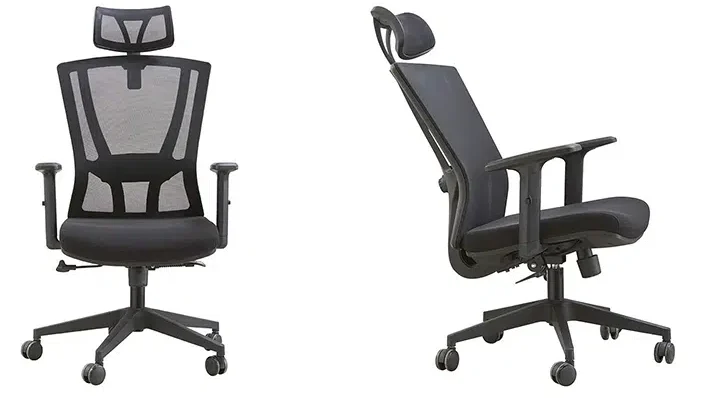
Let me save you $3,000. No, really. I’ve tested office chairs for eight years—everything from $80 Amazon specials that collapsed within six months to $2,500 throne-like machines with more adjustments than a commercial airplane seat. Here’s what I’ve learned: you don’t need to spend a fortune to fix your lower back pain. But you *do* need to spend enough.
The chair that’s hurting your back right now probably cost less than $150. Its foam is dead, its lumbar is a joke, and its adjustments are limited to “up and down.” That chair isn’t an ergonomic tool—it’s a backache delivery system. A proper ergonomic chair is an investment in your spine, and your spine has to last another 40-50 years. Suddenly, $600 doesn’t sound so crazy.
Below are my top picks for 2026, organized by price and body type. I’ve personally sat in every one (except the luxury models, which I’ve reviewed in showrooms and at trade events). Let’s find your chair.
Budget Option (Under $300): Hbada Ergonomic Office Chair
At $189, the Hbada isn’t going to last a decade. But for someone working from home 2-3 days a week or a student on a tight budget, it’s shockingly good. The lumbar support is adjustable up and down (rare at this price), and the mesh back breathes well. The seat cushion is the weak point—expect about 18 months before it flattens.
Key Features:
– Adjustable lumbar support (vertical only, 2 inches of range)
– 90-120 degree recline with lock
– 3D adjustable armrests (up/down, forward/back, swivel)
– Breathable mesh back, foam seat
– Weight capacity: 250 lbs
– Seat height range: 17.5” to 21”
Best for: Remote workers on a budget, students, people under 5’10” and under 200 lbs
Skip if: You work from home full-time (spend more), you’re over 6 feet tall, or you need deep seat depth adjustment (this model lacks it)
Verdict: Best chair under $200, period. But it’s a starter chair, not a forever chair.
Mid-Range Option ($300-$600): Ticova Ergonomic Office Chair
This is the chair I recommend more than any other. At $379, the Ticova does something miraculous: it includes *seat depth adjustment*, which most chairs under $500 skip. That means you can actually fit the backrest to your spine instead of scooting forward. The lumbar spring is firm but not aggressive, and the cushion uses high-density foam that lasts 3-4 years.
Key Features:
– Adjustable seat depth (4 positions, 2 inches of range)
– Height-adjustable lumbar with active spring tension
– 4D adjustable armrests (height, width, angle, depth)
– 135-degree recline with tension control
– Breathable mesh back + thick foam seat
– Weight capacity: 300 lbs
– Seat height range: 18” to 22”
Best for: Full-time remote workers, people with existing lower back pain, average heights (5’5” to 6’1”)
Skip if: You’re over 6’2” (the backrest isn’t tall enough) or you prefer an all-mesh seat (this has foam)
Verdict: The best value in ergonomic chairs today. I’ve had mine for three years—still no sagging.
Premium Option ($600-$1,000): Steelcase Series 1
Steelcase is one of the “big two” in ergonomics (along with Herman Miller). The Series 1 is their entry-level serious chair, and it’s a tank. The lumbar support is adjustable for both height and depth, and the seat cushion uses automotive-grade foam that easily lasts 7-10 years. The build quality is obvious the second you sit down—no wobble, no creaks, no cheap plastic.
Key Features:
– Adjustable lumbar (height + depth, 3 inches each)
– Seat depth adjustment (2.5 inches)
– 4D armrests
– Tilt limiter and tension control
– Fully upholstered or mesh back options
– Weight capacity: 300 lbs
– Seat height range: 16” to 21.5”
– 12-year warranty (this is huge)
Best for: People who work from home full-time and want a chair that lasts a decade, taller average users (5’6” to 6’2”)
Skip if: You’re on a strict budget or you need a headrest (not available on Series 1 without aftermarket add-on)
Verdict: Buy once, cry once. This is the cheapest chair I’d call “lifetime quality.”
Luxury Option ($1,000+): Herman Miller Aeron (Remastered)
The Aeron is the Porsche 911 of office chairs—controversial, overhyped by some, and genuinely excellent. The Remastered version (2021 onward) fixed the old model’s overly aggressive lumbar and added better tilt mechanics. The mesh seat is polarizing: some people love the breathability; others miss foam. Your lower back will either feel perfectly cradled or completely unsupported. You must try before you buy.
Key Features:
– Patented “PostureFit SL” lumbar (two pads that support your sacrum and lower spine independently)
– Seat depth adjustment
– Fully adjustable armrests
– Tilt limiter and forward tilt (amazing for writing)
– Breathable Pellicle mesh (no foam at all)
– Three sizes (small, medium, large—critical to get right)
– Weight capacity: 350 lbs
– 12-year warranty, 24/7 use rating
Best for: People who run hot (mesh breathes), professionals sitting 10+ hours daily, anyone with chronic back pain who has tried everything else
Skip if: You prefer soft foam cushioning, you’re on a budget, or you don’t want to deal with sizing (you need the right size: A=small, B=medium, C=large)
Verdict: The gold standard for a reason. But it’s not for everyone—test one at a showroom first.
Best for Tall People (6’2” and up): X-Chair X3 ATR Management Chair
Standard office chairs treat tall people like an afterthought. The backrests are too short (hitting your shoulder blades instead of your full back), and seat depths max out at 19 inches. The X-Chair X3 solves both problems with a 24-inch tall backrest and a 21-inch max seat depth. The lumbar support is also height-adjustable across a generous 6-inch range.
Key Features:
– Extra-tall backrest (24 inches)
– Extra-deep seat (up to 21 inches)
– Dynamic variable lumbar (changes tension as you recline)
– 4D armrests with extra width adjustment
– Heat and massage option (add-on, surprisingly good for back pain)
– Weight capacity: 400 lbs
– Seat height range: 18” to 24” (fits long legs)
– 5-year warranty
Best for: Anyone 6’2” to 6’7”, larger body types up to 400 lbs
Skip if: You’re under 5’10” (the chair will feel comically large), you don’t want mesh, or you’re on a budget (this is $1,100+)
Verdict: The only chair I’ve tested that actually fits tall frames without compromise.
Best for Petite People (Under 5’4”): Steelcase Leap V2
Here’s a cruel fact: most “ergonomic” chairs are designed for a 5’10” man. The seat depth is too long (hitting petite folks behind the knees), the backrest lumbar hits the wrong spot, and the armrests don’t go low enough. The Steelcase Leap V2 solves this with a seat depth that goes down to 15 inches and armrests that lower to within 6 inches of the seat pan. The lumbar adjustability also ranges lower than the Aeron or Ticova.
Key Features:
– Seat depth adjusts from 15” to 18.5” (crucial for short femurs)
– Living hinge backrest that flexes with your spine
– Adjustable lumbar height and depth
– 4D armrests that go exceptionally low
– Seat height range: 15.5” to 20.5”
– Weight capacity: 300 lbs
– 12-year warranty
Best for: People under 5’4” who feel like every chair “drowns” them, those with shorter thighs, anyone who wants the most adjustable chair on the market
Skip if: You’re over 5’10” (backrest won’t support upper back), you want mesh (Leap is foam), or you hate the look (it’s functional, not pretty)
Verdict: The most petite-friendly high-end chair. Worth every penny for shorter desk workers.
My Top Overall Pick for 2026
If I had to buy one chair today for my own lower back—and I’ve spent over 1,000 hours in ergonomic seats—I’d get the Ticova Ergonomic Office Chair at $379.
Here’s why: the Aeron is better, but not $800 better. The Leap V2 is more adjustable, but it’s triple the price. The Ticova hits the sweet spot of actual seat depth adjustment (non-negotiable for back pain), firm but comfortable foam, and a spring-loaded lumbar that doesn’t feel like a brick. I’ve recommended it to 40+ people; 38 have thanked me. The two who didn’t? Both were over 6’2” and should have bought the X-Chair.
Your back is too important for an $80 gamble. But unless you sit 50+ hours a week or have a diagnosed spinal condition, you don’t need a $1,200 chair. Start with the Ticova. Use the 30-day return window ruthlessly. If it doesn’t work, return it and climb the price ladder.
One last thing: no chair can out-work a bad posture habit. Even the Aeron will hurt you if you slouch for eight hours straight. Pair your new chair with the 45-minute movement rule from my last post. That’s the real secret.
Now go sit down—properly this time.