
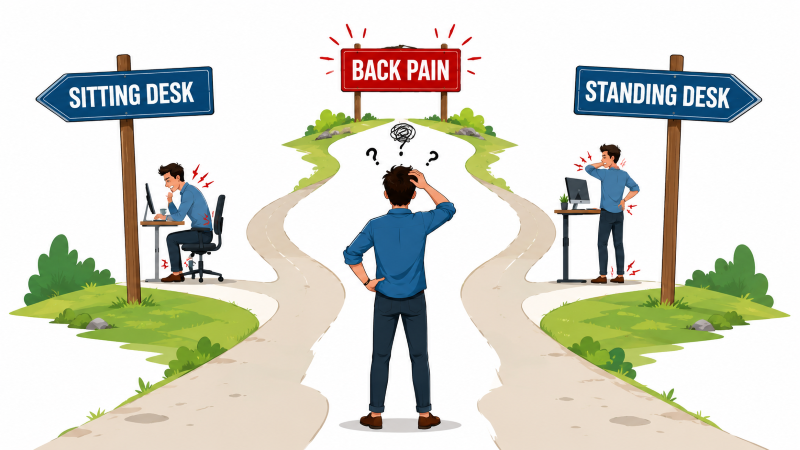
I get this question constantly: “Should I buy a standing desk? Will it fix my back pain?” And honestly? I would give the same answer everyone else gives—“Yes, standing desks are the future!”
Then I dug into the research. And I realized all is not as it seems!
Here’s the uncomfortable truth: the standing desk vs sitting desk debate is a trap. Both sides are selling you a fantasy. Sitting all day is bad for you. Standing all day is also bad for you. The real question isn’t which desk—it’s how do you create a dynamic workday?
If you’ve been Googling “standing desk vs sitting back pain,” you’re not alone. Back pain is the leading cause of disability worldwide, and desk workers suffer the most—up to 83% of office workers experience lower back pain every single year .
But the solution isn’t picking a side. The solution is breaking free from the binary altogether.
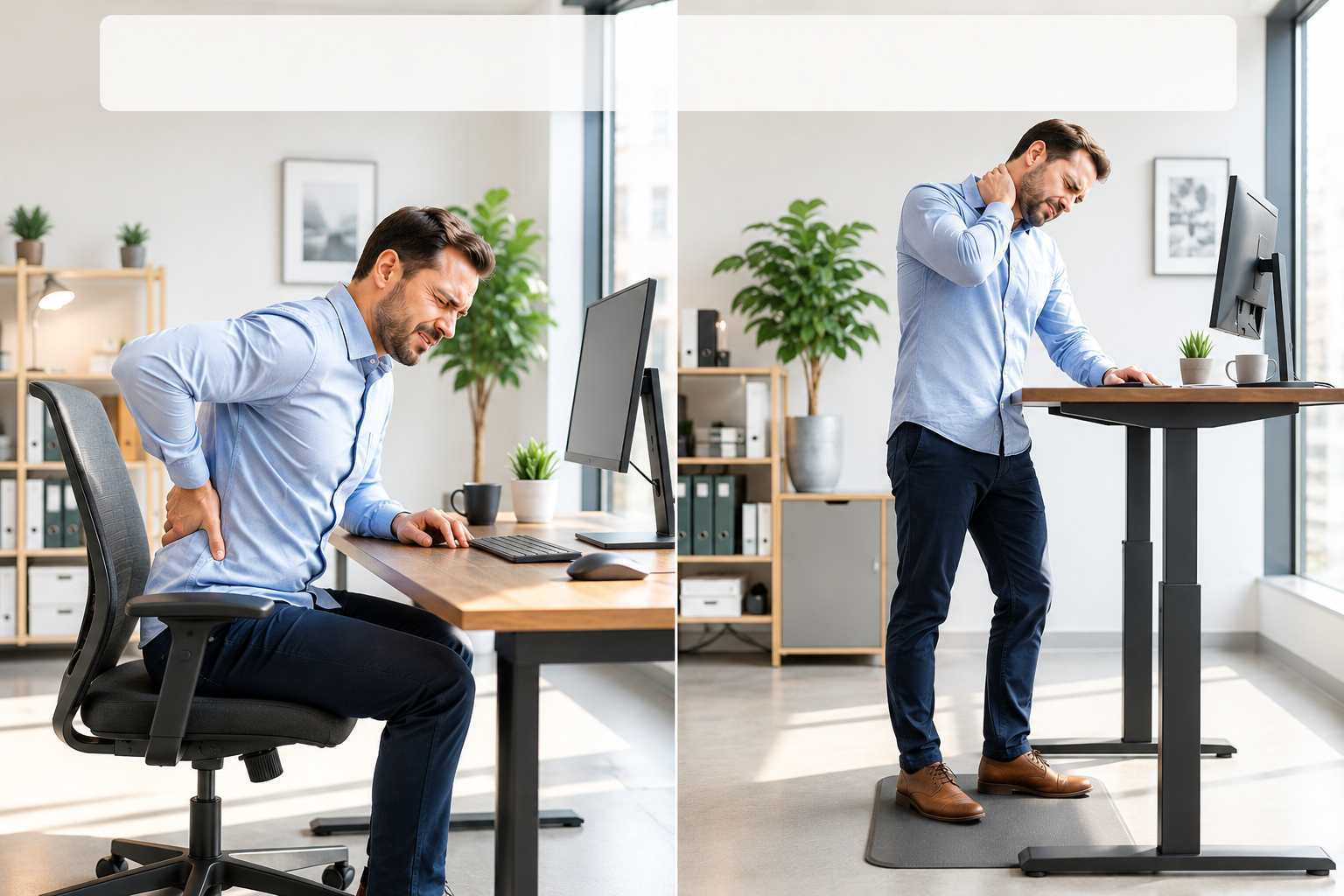
A systematic review and meta-analysis found that objectively measured prolonged standing during desk work does NOT induce significantly less perceived low back pain compared to sitting . Let that sink in. Standing doesn’t fix the problem. It just moves it to your legs and feet.
The Problem with Prolonged Sitting
We all know sitting too much is bad. But let me tell you why in plain terms.
When you sit for hours on end, a few nasty things happen:
- Your spinal discs get compressed unevenly
- Your hip flexors shorten and tighten
- Your core muscles switch off
- Your neck cranks forward (hello, “tech neck”)
- Your metabolism slows to a crawl
The numbers are staggering. Lower back pain alone accounts for approximately 264 million lost workdays per year in the US . That’s more than any other occupational musculoskeletal condition.
But here’s the part people gloss over: the problem isn’t sitting. It’s prolonged sitting—sitting in one position for 30+ minutes without a break. The research consistently shows that bouts of sitting lasting longer than 30 minutes are what drive pain and dysfunction .
The Problem with Prolonged Standing
Now, the standing desk evangelists will tell you to just stand all day. That’s bad advice.
Prolonged standing comes with its own laundry list of problems:
- Blood pools in your legs and feet
- Your lower back muscles fatigue from constant activation
- Your knees and feet ache
- Varicose veins can develop over time
- Your neck and shoulders stiffen from holding the position
The Canadian Centre for Occupational Health and Safety (CCOHS) clearly states that working in a standing position on a regular basis can cause sore feet, swelling of the legs, varicose veins, general muscular fatigue, low back pain, and stiffness in the neck and shoulders .
One study found that standing for more than 40 minutes without a break starts to significantly increase lower back pain risk . So if you buy a standing desk and immediately stand for three hours straight, you haven’t improved anything—you’ve just traded one pain for another.
If you have chronic venous insufficiency, severe varicose veins, or arthritis, you should consult a doctor before using a standing desk at all .
The Science-Based Solution: Postural Variation
Here’s where it gets good.
A 2026 study published in Applied Ergonomics tested two approaches with office workers who already had lower back pain:
- A fixed ratio of 30 minutes sitting, 15 minutes standing (alternating every 45 minutes)
- A personalised ratio where participants chose their own sitting/standing schedule
The fixed ratio group won. Hands down.
After 3 months:
- Fixed ratio participants reduced their daily worst pain by 1.33 points (on a 0-10 scale)
- Fixed ratio participants reduced their daily average pain by 0.83 points
- Personalised ratio participants only reduced their worst pain by 0.69 points—and their average pain barely changed
The fixed 30:15 group also reported better concentration, less job-related stress, and fewer work impairments due to back pain.
Why did the fixed schedule work better? Adherence. 72% of the fixed group stuck to the routine at least five times per day. Only 29% of the personalised group did the same . The personalised group ended up sitting for over two hours at a time—and standing for 45 minutes at a time. That’s just trading one prolonged posture for another.
How to Implement Your 30:15 Routine
Here’s your action plan, step by step:
- Set a timer.Every 45 minutes, you switch. 30 minutes sitting, 15 minutes standing. No exceptions. Use your phone, a smartwatch, or a desktop app. Just do it.
- Set up your sitting position properly.The CCOHS ergonomic checklist for sitting:
- Feet flat on the floor (use a footrest if needed)
- Knees level with or slightly lower than your hips
- Lower back fully supported by your chair’s lumbar support
- Shoulders relaxed, elbows at 90 degrees
- Monitor at eye level—top third of screen at or just below your natural gaze
- Set up your standing position properly.When you stand:
- Desk height at elbow height—your forearms should be parallel to the floor
- Monitor screen at eye level (use a riser if needed)
- Shoulders relaxed, not hunched
- Stand squarely in front of the monitor
- Wear supportive shoes and stand on an anti-fatigue mat
One note from Dr. Parini Patel at Atlantic Health: “A standing desk isn’t a replacement for a sitting desk. The goal isn’t to stand all day; it’s to avoid staying seated for too long.”
The Big Picture Strategy
Listen: the 30:15 routine is a powerful tool, but it’s not the whole solution.
The research is clear that the goal is to reduce and regularly break up prolonged sedentary time . That means the 30:15 ratio is a starting point, not a replacement for actually moving your body.
Here’s what I personally do:
- 30 minutes sitting, 15 minutes standing (the fixed ratio)
- Every time I switch, I do one small movement—a neck stretch, a shoulder roll, a quick walk to get water
- I take a 5-minute walking break every 2 hours (even if it’s just to the bathroom and back)
- I never, ever stay in any position for more than 45 minutes
Dr. Parini Patel puts it perfectly: “The human body is designed to sit, but also to stand, walk, squat, bend and move. Too many office workers don’t move enough.”
Conclusion & Call to Action
So, what’s the final verdict on the standing desk vs sitting desk debate?
Neither is better. Both are worse—if you stay in either position for too long.
The science is crystal clear: alternating every 45 minutes using a 30:15 ratio reduces lower back pain, improves concentration, and lowers stress. The fixed schedule beats a flexible one because it removes the decision fatigue. You just follow the timer.
Here’s my challenge to you: Try the 30:15 ratio for one week.
Set a timer on your phone right now—30 minutes sitting, 15 minutes standing. Alternate every 45 minutes. Pay attention to your back at the end of each day.
If it works for you, drop a comment and let me know. If it doesn’t, adjust. The beauty of this approach is that it’s evidence-based and flexible enough to fit your workflow.
Your spine doesn’t care which desk you buy. It cares about one thing: movement.
Key Takeaway Box
| Myth | Truth |
| Sitting all day causes back pain | Prolonged static sitting causes back pain |
| Standing all day fixes back pain | Prolonged static standing also causes back pain |
| You need a personalised sit-stand schedule | A fixed 30:15 ratio (30 min sitting, 15 min standing) is more effective |
| Any movement is enough | You need to alternate every 45 minutes minimum |
| Standing desks are the solution | Postural variation is the solution—standing desks are just a tool |
Set your timer now. Your back will thank you in a week.