
Let me be blunt: a new Herman Miller Aeron costs $1,200. A used one costs $400. That’s an $800 difference—enough for a nice weekend trip, a new monitor, or three months of groceries. So yeah, buying used is tempting. I’ve done it. Twice. And I’ve also bought used chairs that were complete disasters.
After a decade of sitting in (and flipping) ergonomic chairs, I’ve learned exactly when used is a steal and when it’s a trap. This post will save you money—or save you from wasting it.
Why New Chairs Hurt Your Wallet
The companies making high-end ergonomic chairs (Steelcase, Herman Miller, Haworth) don’t compete on price. They compete on durability and warranty. A new Steelcase Leap V2 comes with a 12-year warranty, 24/7 construction, and foam that’s tested for a decade of use. That’s why it costs $1,100.
But here’s the thing: most people don’t need 12-year durability. They need a chair that works well for 3-5 years. And that’s where the used market shines—if you know what you’re doing.
The Pros of Buying Used (There Are Real Upsides)
Price is the obvious one. A used Steelcase Series 1 that retails for $699 can often be found for $250-$350. That’s mid-range pricing for premium build quality. I’ve personally bought a used Haworth Zody for $180 and sat in it for four years before selling it for $150.
Chairs come “broken in.” New ergonomic chairs often feel stiff—lumbar support too aggressive, recline tension too tight. A used chair has already been broken in by someone else’s posterior. This isn’t a joke. Many people prefer a 2-3 year old Aeron because the mesh has relaxed perfectly.
Environmentally friendly. chairs are mostly metal and plastic. They don’t biodegrade. Buying used keeps a perfectly functional chair out of a landfill. If that matters to you (it should), used is the ethical choice.
The Cons of Buying Used (Be Honest With Yourself)
No warranty, period. That 12-year warranty on a new Steelcase? Gone the second you buy used. If the gas cylinder fails in six months, you’re buying a $40 replacement and wrestling it out with a pipe wrench. If the mesh rips, you’re shopping for a used seat pan on eBay.
Unknown wear and abuse. That “gently used” chair from a Facebook Marketplace seller might have supported a 300-pound person who bounced on it like a trampoline. You can’t see internal foam compression or stressed plastic hinges. You’re trusting a stranger.
Odors, stains, and pet hair. I once drove an hour to pick up a “like new” Steelcase Think only to find it smelled like cigarette smoke and wet dog. The seller said “I didn’t notice.” Sure. Fabric chairs are especially risky—they absorb sweat, coffee, and worse.
Missing parts. Used chairs often come with non-original casters (cheap ones that scratch floors), missing armrest pads, or stripped adjustment levers. By the time you buy replacements, you could have bought new.
What to Inspect Before Buying a Used Chair (Checklist)
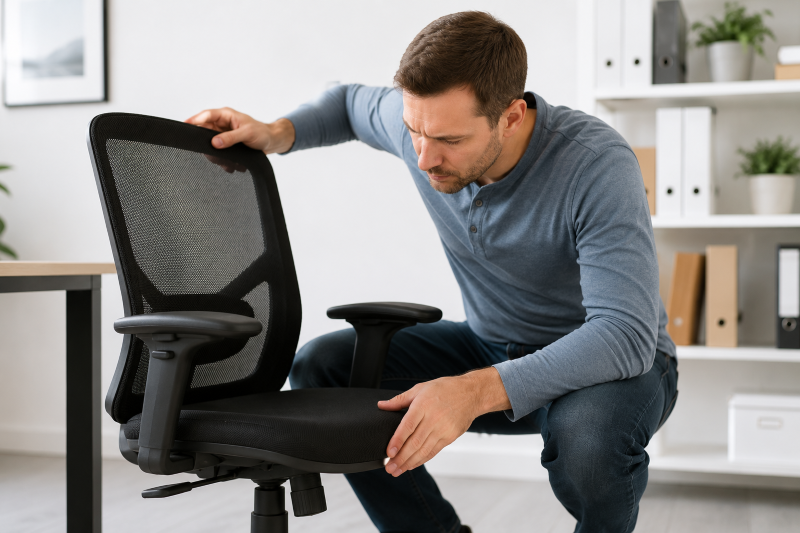
If you decide to buy used, inspect in person. Never buy sight-unseen from eBay or Facebook Marketplace without sitting in it first. Bring this checklist:
- Gas lift (height adjustment). Sit in the chair. Raise it to max height. Does it move smoothly? Lower it fully. Does it drop evenly or stick? Then sit in it at full height and see if it slowly sinks over 30 seconds. A sinking chair needs a new gas cylinder ($20-40 and a lot of swearing).
- Armrests. Adjust them through all motions (up/down, in/out, swivel, angle). Wobbly armrests mean worn mechanisms. Missing adjustment paddles are a dealbreaker—replacements cost $30-60 per side.
- Mesh or fabric. For mesh chairs (Aeron, Zody), run your fingernail across the mesh. Does it feel frayed? Look for pulled threads or stretched areas, especially at the front edge where thighs press. For fabric, press your palm into the seat—does it spring back or feel like hard foam? Any stains that look like water rings (sweat) are permanent.
- Casters (wheels). Roll the chair on a hard floor. Do all five wheels spin freely? Do any feel flat-spotted or crunchy? Replacements are cheap ($15-20 for a full set), but they’re a bargaining chip.
- Recline and tilt mechanism. Lean all the way back. Does the chair move smoothly or does it jerk? Engage the tilt lock—does it hold firmly? Turn the tension knob from min to max—should feel obvious resistance change. Any grinding sounds means internal damage.
- Seat depth adjustment (if equipped). Slide the seat pan forward and back. It should click into distinct positions. If it slides loosely, the mechanism is stripped.
Where to Find Used Ergonomic Chairs
Facebook Marketplace: The best source by far. Search for “Steelcase,” “Herman Miller,” “Haworth,” or “ergonomic chair.” Sort by new. Look for office liquidation posts—they often have 20+ chairs at once.
Craigslist: Still viable in larger cities. More likely to find individual sellers. Use the same search terms. Be wary of posts with stock photos instead of real pictures.
Office liquidation companies: Search “office furniture liquidation [your city].” These companies buy chairs from closing businesses by the truckload. They usually clean and test them. Prices are higher than private party (maybe $350 for an Aeron instead of $300), but you get some basic assurance.
Ebay (local pickup only). Filter by distance and look for “local pickup.” Shipping a used chair costs $50-100 and often damages it.
Avoid: OfferUp (low volume), Nextdoor (overpriced), and thrift stores (usually broken budget chairs, not ergonomic brands).
Price Guide: What’s a Deal vs. Too Expensive
Here are fair used prices (private party, not liquidator) for common high-end chairs in good working condition:
| Chair | New Price | Good Used Price | Too Expensive | Steal Price |
|——-|———–|—————-|—————|————–|
| Herman Miller Aeron (classic) | $900 | $300-400 | >$500 | <$250 |
| Herman Miller Aeron (remastered) | $1,200+ | $500-650 | >$750 | <$450 |
| Steelcase Leap V2 | $1,100 | $350-450 | >$550 | <$300 |
| Steelcase Gesture | $1,300 | $500-650 | >$700 | <$450 |
| Steelcase Series 1 | $700 | $200-300 | >$350 | <$150 |
| Haworth Zody | $800 | $250-350 | >$400 | <$200 |
| Haworth Fern | $1,000 | $400-550 | >$650 | <$350 |
Rule of thumb: 30-40% of new price is fair for a chair in good condition. 50%+ is overpriced unless it’s nearly new with tags. Anything under 20% of new is suspicious—probably broken or stolen.
The Final Verdict: Who Should Buy Used vs. New
Buy used if:
– You’re on a tight budget (under $400 total)
– You’re handy and don’t mind replacing a gas cylinder or casters yourself
– You want a premium brand (Steelcase, Herman Miller) but can’t afford new
– You live in a major city with lots of office liquidations
– You’re buying a mesh chair (Aeron, Zody) because mesh is easier to inspect than foam
Buy new if:
– You have a diagnosed back condition and need consistent support
– You’re over 250 lbs (used chairs with foam may have unseen compression)
– You want a full 12-year warranty and don’t want to think about repairs
– You’re buying fabric or leather (too risky for hidden odors/stains)
– Your time is valuable enough that hunting for a deal isn’t worth it
My personal take: I buy used for secondary chairs (guest chair, home office spare) and new for my primary 8+ hour chair. Why? Because my back isn’t a place to gamble. A $400 used Aeron is a great deal—until you realize the previous owner’s wear pattern doesn’t match your spine. I learned that the hard way.
That said, if you find a used Steelcase Leap V2 for $350 that passes the inspection checklist above, buy it immediately. Then sell it for $450 a year later when you upgrade. Used chairs hold their value surprisingly well.
One last warning: don’t buy a used budget chair (anything that retailed under $200 new). They’re already low-quality. Used just means worn-out low-quality. Stick to the premium brands even in the used market.
Your back deserves better than a gamble. But your wallet also deserves better than $1,200. Meet in the middle: inspect, negotiate, and buy used only when you can touch it first.